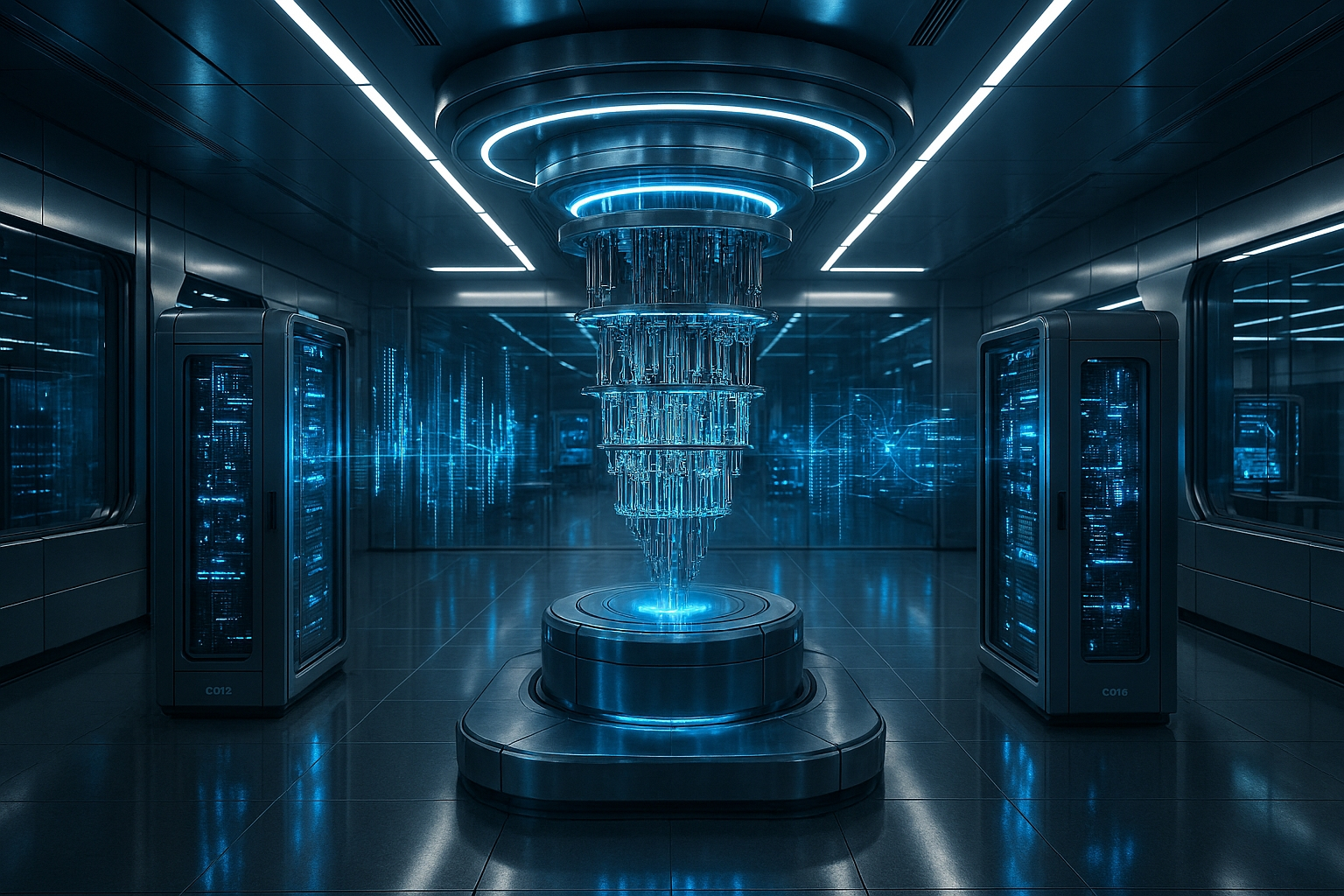
A gilded future archive chamber opening onto a luminous city, with the monumental SPHERING³ crest set into the central window.

Temporal arrival complete · Continuarium epoch

The SPHERING³ Grand Tour

What must not be lost?

One work. The evidence a life depends on. The memory civilization cannot recreate.

Begin with the concern · follow the evidence

Trust begins with proof you can inspect.

Choose the concern closest to yours. Each path opens the relevant custody boundary, operating control, guided experience, evidence record, or continuity mechanism.

  1. Concern 01

    I do not want hidden software taking over my device.

    It sounds like control, permissions, and a clear exit need to be visible before any system earns a place on your device.

    Would an inspectable control boundary answer that concern?

    Inspect the control boundary
  2. Concern 02

    I will not hand you my files.

    It sounds like your files should remain on your device unless you explicitly choose another destination.

    Would a workspace that performs the file work on your device answer that concern?

    See what stays on your device
  3. Concern 03

    This sounds too complicated.

    It sounds like preservation should arrive as a prepared experience, not another technical project.

    Would a guided path that opens already prepared make the process feel manageable?

    Take the guided journey
  4. Concern 04

    Those are extraordinary promises. Where is the proof?

    It sounds like extraordinary continuity claims should be supported by visible authentication, connected evidence, and inspectable recovery paths.

    Which evidence would you want to inspect first?

    Inspect architecture and evidence
  5. Concern 05

    I do not want another subscription, lock-in, or permanent service relationship.

    It sounds like durable ownership should include a usable exit, portable evidence, and recovery across accounts, devices, and services.

    Would portable evidence and an explicit recovery path answer the lock-in concern?

    Inspect ownership, exit, and recovery

The Thorium Living Twin · five-stage operating model

The instrument remains real. The invisible becomes visible.

Each stage exposes its purpose, device boundary, user decision, and evidence relationship without disclosing the protected machinery beneath it.

Thorium Reactor emblemThorium Reactor identity

Five stages. One user-authorized canonical act.

InstrumentDevice-local sourceEvidence processCanonical fingerprint
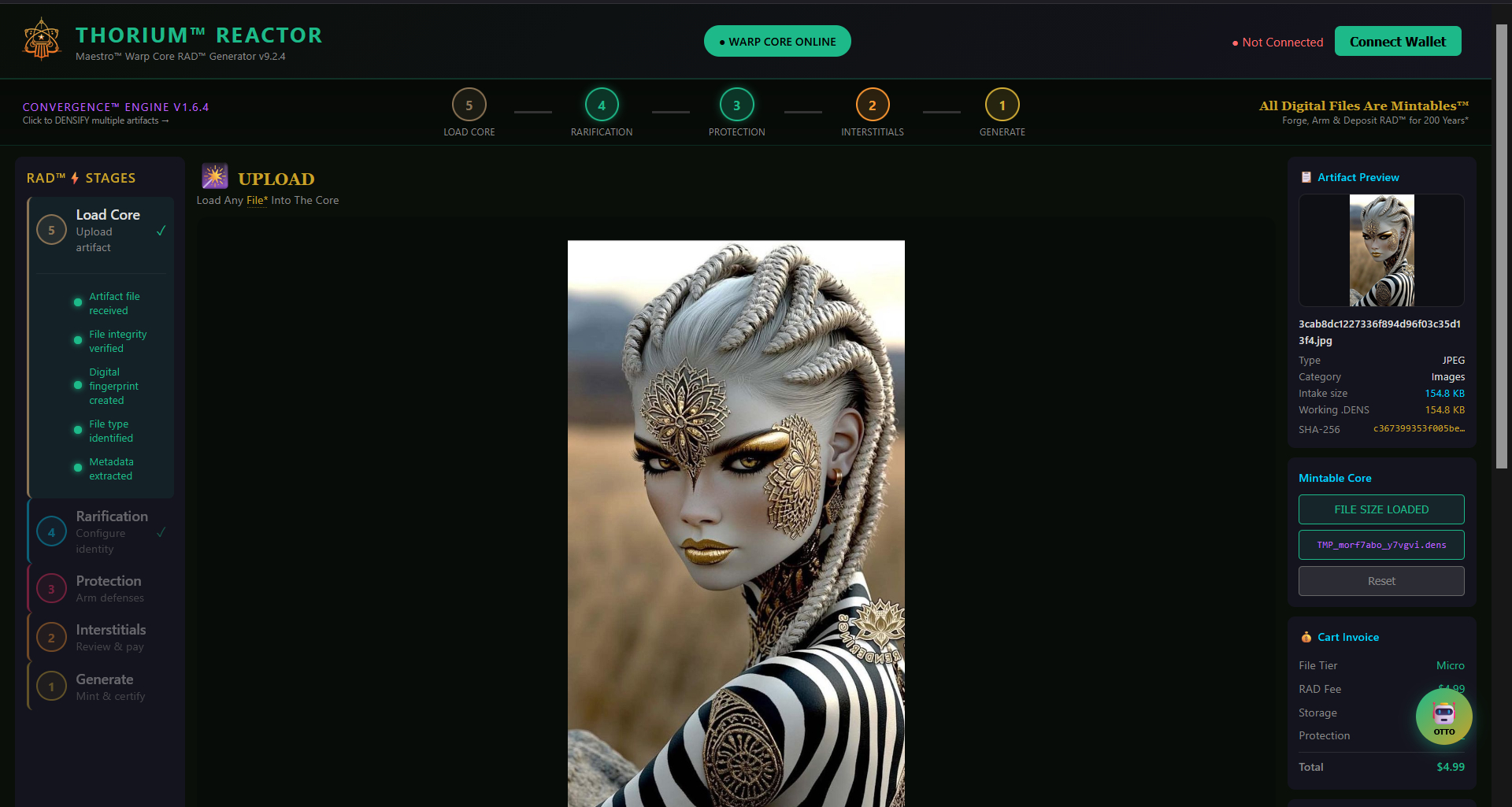
Thorium Reactor Upload stage with a loaded artifact and visible intake factsThorium Reactor Upload
Choose one artifact
5

Load Core

Thorium reads the selected artifact on the device, validates readability, derives visible file facts, and computes SHA-256.

Follow the sequence

THORIUM05

THORIUM · 5 · UPLOAD

The file that arrived without a future

Before anything can be preserved, it must be known exactly.

RECORDED LOCAL COMPUTATIONRecorded local computation · registered demonstration artifact · device-local review

Recorded local evidence · registered demonstration fixtures · visitor files remain on device
A file often begins its second life with almost nothing: a name that can be changed, an extension that can mislead, and a folder someone else may never understand. It may be precious, but the machine sees only bytes.

Upload is the first act of recognition. THORIUM reads the selected artifact locally, makes its visible facts inspectable, and computes the SHA-256 fingerprint that distinguishes these exact bytes from every altered copy. The person remains in control of the next step; the interface waits for an explicit acceptance before the journey continues.

The drama here is quiet but decisive. A future record cannot depend on “I think this is the right one.” It begins with an identity that can be checked again.

Read the complete transcript

The file that arrived without a future

Before anything can be preserved, it must be known exactly.

A file often begins its second life with almost nothing: a name that can be changed, an extension that can mislead, and a folder someone else may never understand. It may be precious, but the machine sees only bytes.

Upload is the first act of recognition. THORIUM reads the selected artifact locally, makes its visible facts inspectable, and computes the SHA-256 fingerprint that distinguishes these exact bytes from every altered copy. The person remains in control of the next step; the interface waits for an explicit acceptance before the journey continues.

The drama here is quiet but decisive. A future record cannot depend on “I think this is the right one.” It begins with an identity that can be checked again.

Recorded evidence: the demonstration artifact, its visible file facts, its browser-computed SHA-256, and the explicit acceptance gate. Viewing the film is observational; visitor files and transactions remain untouched.

Recorded local computation · registered demonstration artifact · device-local review

Recorded local evidence · registered demonstration fixtures · visitor files remain on device
Open the plain-text transcript
Process evidence

Continuarium · Neural Mnemonics™ · CODAX · COFA

The device is the home. The mirror is only a reflection.

Thorium forges the RAD.

Continuarium provides custody and access.

The device-local Vault is the home for the record. Finding follows the access protocols established at mint; an optional online Continuarium mirror is a separate, explicit continuity choice governed by the user.

Rich artifact context—including file-derived data, carrier, location, device, identity, and user-added provenance—stays with the device-held record. SPHERING³ retains the transaction-closeout and compliance evidence authorized for continuity.

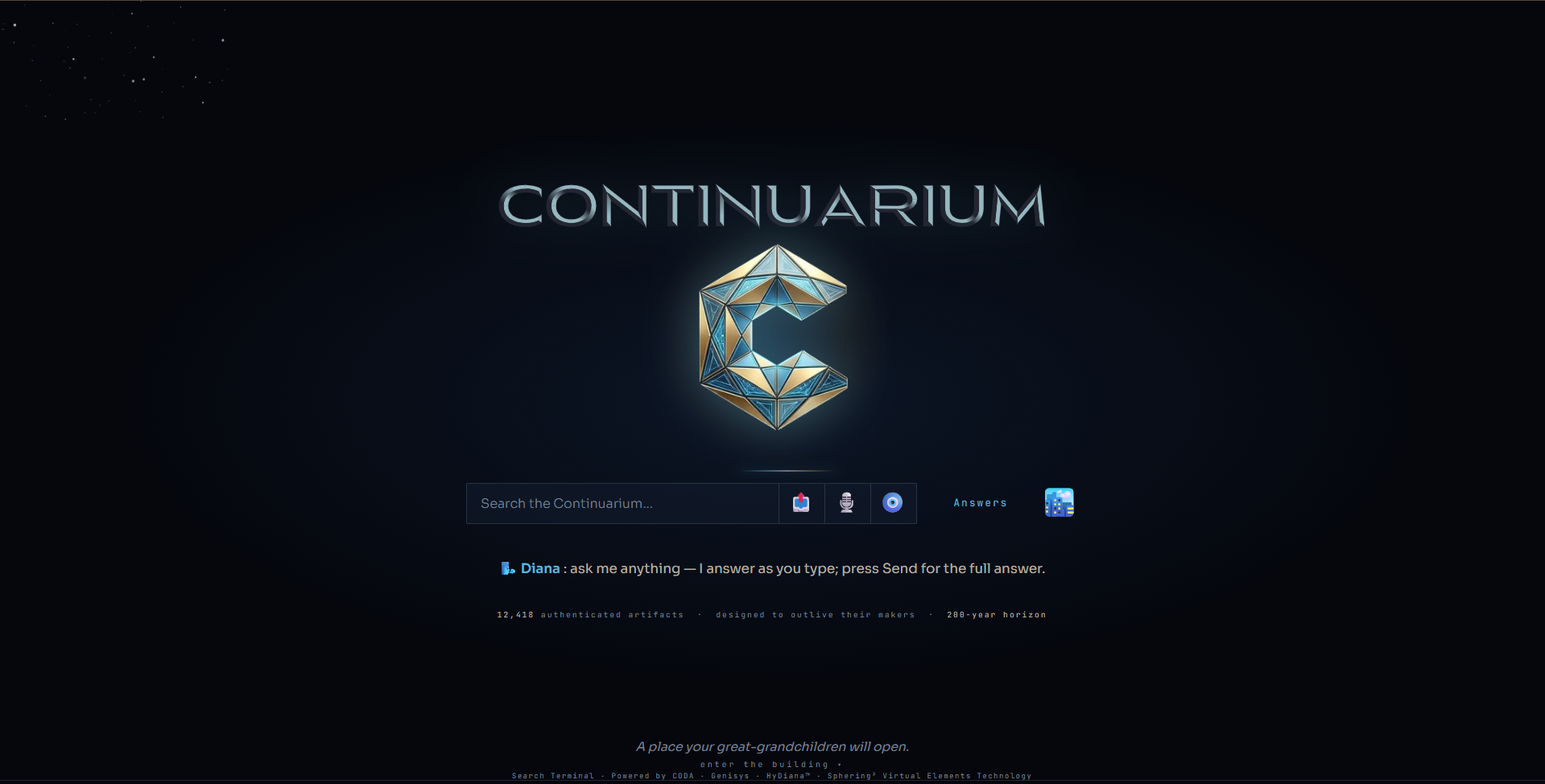
  1. Dark Continuarium home interface with a faceted C emblem, central search field, and Diana assistant prompt
    01 · Continuarium HomeThe Continuarium search-and-arrival interface. The device remains the home; each reflection follows explicit user authority.Visit Continuarium ↗
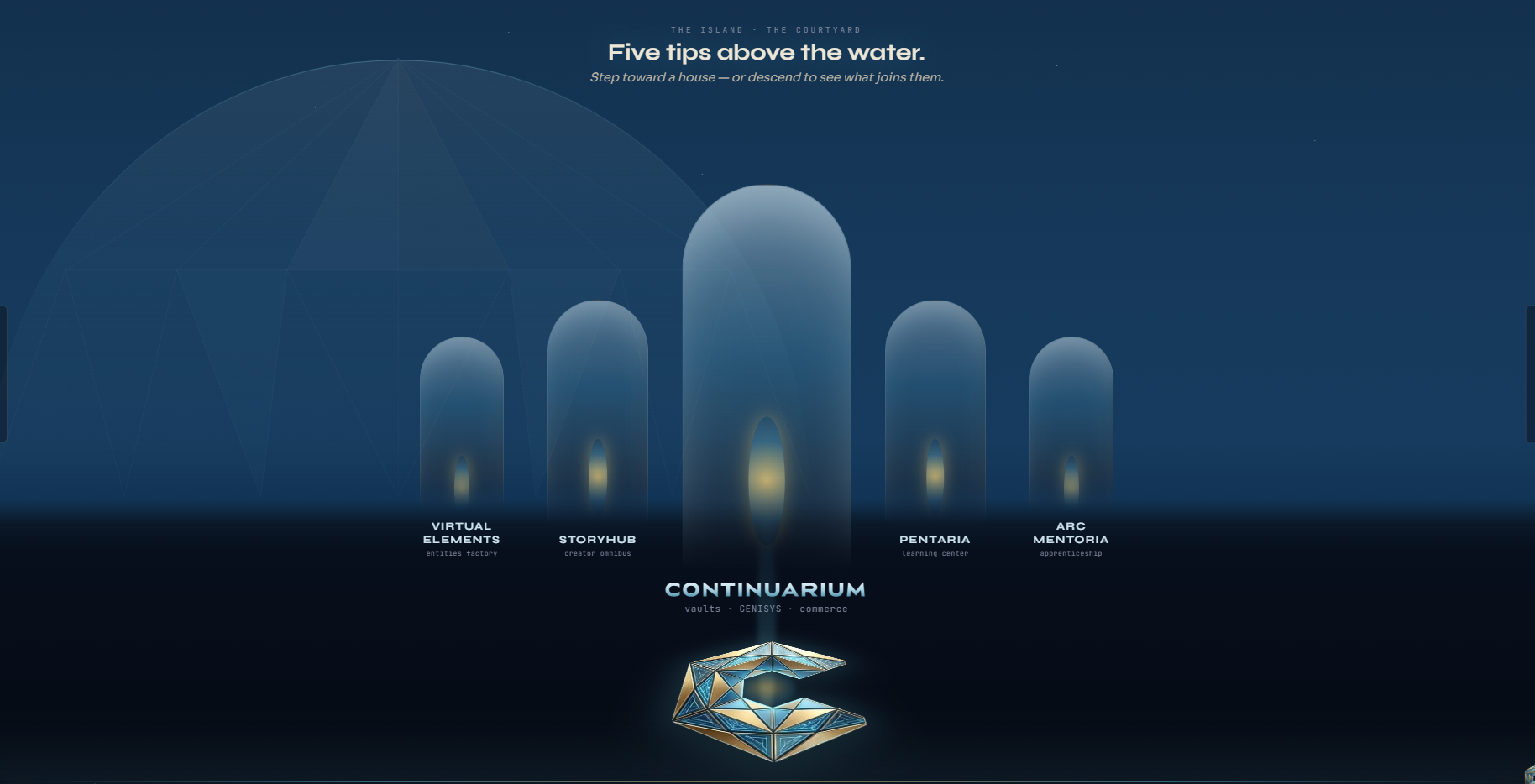
  2. Continuarium Courtyard showing five illuminated paths for Virtual Elements, StoryHub, Continuarium, Pentaria, and Arc Mentoria
    02 · The Courtyard · Path SelectorFive connected paths: Virtual Elements, StoryHub, Continuarium, Pentaria, and Arc Mentoria.
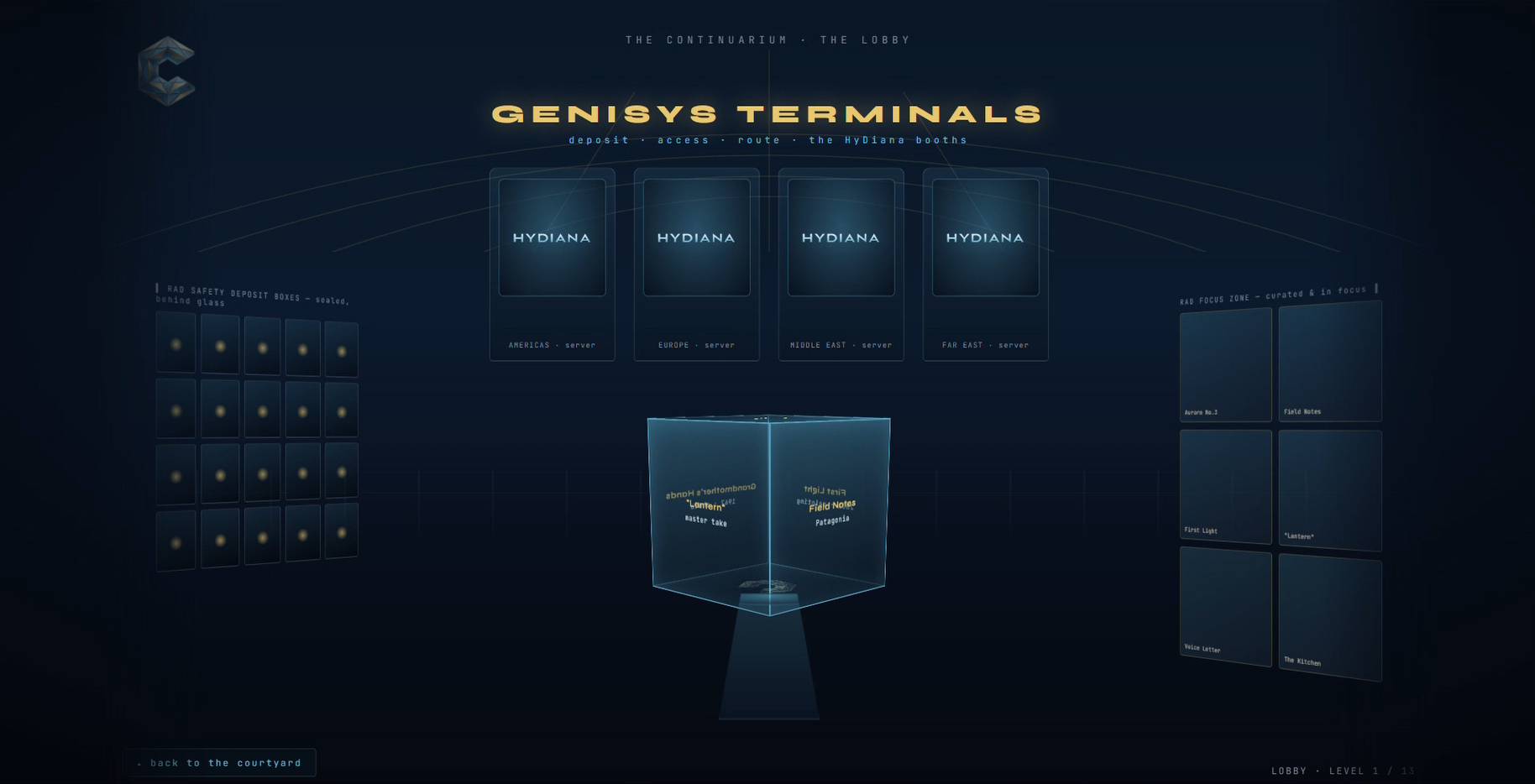
  3. Continuarium private lobby with four GENISYS terminals, sealed artifact boxes, curated displays, and a central glass cube
    03 · Continuarium Private LobbyThe GENISYS lobby: regional HyDiana terminals, sealed RAD deposit boxes, and curated works within one hall.

Custody and access register

Four boundaries, each with its own evidence.

Regional continuity

Four HyDiana terminals

Americas, Europe, Middle East, and Far East terminals provide Hydie deposit-and-encode and Diana access-and-route roles.

Custody
User-governed destination and access authority
Continuity
Regional deposit, routing, and recovery relationships
Remembered access

Neural Mnemonics™

Music, rhythm, phrase, lyric, poetry, spoken language, keyboard, percussion, graph, encoder, and decoder surfaces can become factors within a user-defined access policy.

Authority
User-selected access policy
Factors
CODAX, CODAgraph, Neural Signet, and governed credentials
Permanent transaction map

COFA treasure map

COFA maps the canonical transaction, its receipts, authorized destinations, access routes, and recovery relationships.

Identity
Canonical artifact and transaction references
Recovery
Authorized routes, receipts, and preservation destinations
Device-held custody

Optional Vault mirror

The device is the home. A Continuarium mirror is an explicitly chosen reflection that expands continuity without replacing user authority.

Default
Device-local Vault
Choice
Explicit Continuarium reflection

Accountless finding · user-governed access

Accountless, mirrorless finding is the retrieval premise.

DIANA finds the permanent transaction without account lookup or a required mirror. FIND resolves the transaction; UNLOCK satisfies the access policy established at mint.

FIND

Resolve the permanent transaction.

With COFA, follow the direct treasure map. Without COFA, DIANA uses description, RAD-finding evidence, and the access protocols established at mint.

UNLOCK

Satisfy the user-defined access policy.

Neural Mnemonics is one possible factor among credentials, codes, QR/CODAgraph routes, AI-aided provenance, repository routines, and deliberately public paths.

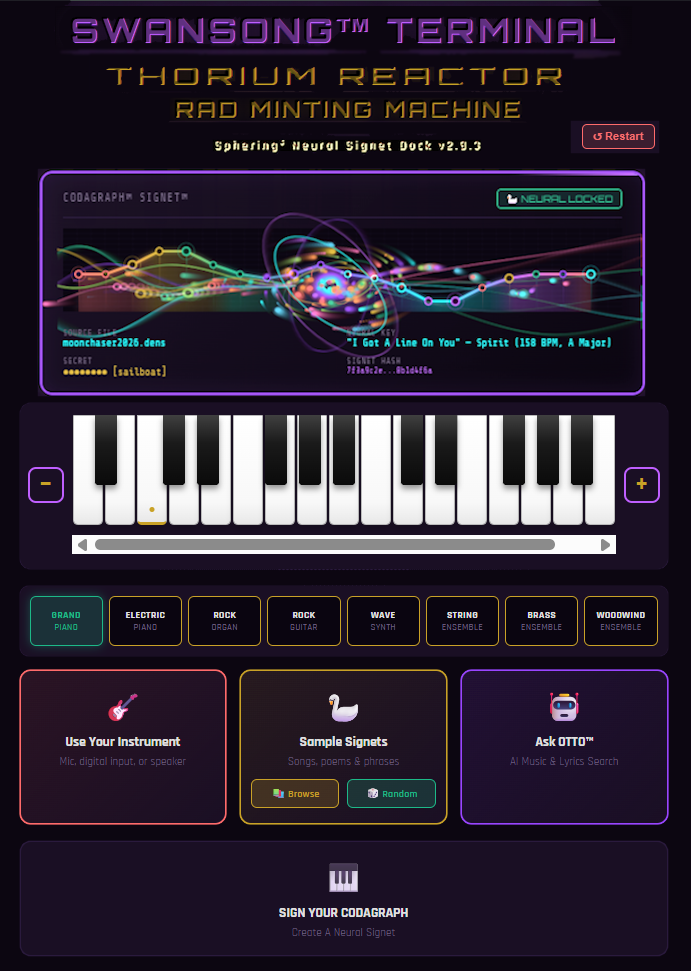
HyDiana Swansong terminal showing a CODAgraph neural signet and musical input controls
HyDiana Terminal · Neural Mnemonics access surfaceMnemonic factors remain governed by the user's wider access policy.

Neural Mnemonics™

Remember with the pathway your mind already knows.

Music, cadence, phrase, poetry, lyric, rhythm, keyboard, percussion, and color-coded graph inputs can form one factor within the user-defined access policy.

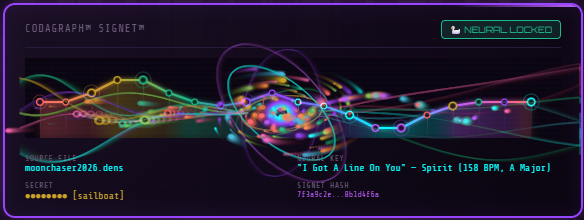
CODAX, CODAgraph, and the Neural Signet remain distinct components. Together with governed credentials and recovery routes, they make remembered access expressive without surrendering policy control.

Neural Mnemonics supplies one factor within a wider policy; access never depends on a lone musical password.

CODAgraph Neural Signet reference image with a color-coded mnemonic graph
CODAgraph Neural Signet · remembered-access mapIdentity, route, and access factors remain separately governed.

COFA · acknowledgement-gated closeout

The user acknowledgement is the gate, not an afterthought.

Receipt-gated
  1. Mint completes and emits its receipt chain
  2. COFA dispatches to the user-designated destination
  3. User accepts the specific acknowledgement and presses Send
  4. ABACUS/TRANSLOG seats and closes the transaction

Every step carries a linked receipt: canonical act, COFA dispatch, user acknowledgement, and ABACUS/TRANSLOG closeout remain one searchable transaction history.

Browser-local evidence · one artifact

RAD continuity emblem: the lost thirteenth month and missing treasure history must not forget

Preserve one artifact without leaving this device

Device-local

Choose something, describe why it matters, then inspect the evidence formed from its actual local bytes.

This local review instrument accepts files up to 25 MiB.

  1. Choose
  2. Describe
  3. Inspect
  4. Sample COFA

Choose

Your file stays on this device.

Three horizons · one foundational power

Empathy changes scale without changing its nature.

The archival inversion

Printing stops being the survival event.

Canonical process

Paper-first past

  1. Create
  2. Print
  3. Warehouse
  4. Decay
  5. Digitize what survives

Mint-first future

  1. Create
  2. Mint canonical source
  3. Preserve + verify
  4. Print/render on demand

The canonical act carries identity, evidence, custody, and recovery forward. Physical originals remain treasures without remaining the only bearer of survival.

Trust is inspectable

No promise stands alone.

Reassurance follows a mechanism whose evidence, controls, and user authority are visible.

  1. 01

    Promise

    State the outcome in ordinary language.

  2. 02

    Mechanism

    Show the operation that produces the outcome.

  3. 03

    Evidence

    Bind the artifact to provenance, receipts, and reproducible proof.

  4. 04

    Controls

    Make protection, custody, access, and recovery inspectable.

  5. 05

    User authority

    Keep permission, correction, export, and exit understandable.

  6. 06

    Recourse

    Preserve a human path when a record or system is disputed.